Maxwell Food Centre in the heart of Singapore’s Chinatown, as seen in the photo above, is a famous, bustling hawker centre frequented by Singaporeans young and old. Surrounding Chinatown are various office buildings and workspaces – you can imagine how packed lunch hour must be. To that end, Maxwell Food Centre certainly faces competition from air-conditioned restaurant chains and ever-popular fast-food outlets like McDonalds or KFC. Yet, and it is with pride I say this, the uniquely Singaporean Maxwell Food Centre continues to thrive as visitors continue to frequent their favourite hawkers, some of whom have been working in the trade and honing the craft for longer than I’ve been alive.
The food geography of Chinatown can be seen in various other neighbourhoods across the island. Small hawkers and street food peddlers are able to coexist alongside dominant restaurant chains and upmarket eateries. Why is this so? How do individual firms manoeuvre within their industry, and how do industries operate? These questions will be answered in this edition of H2: Inside Out, on Firms and Decisions.
Objectives of Firms
Previous chapters of H2: Inside-Out discussed the existence of various economic agents and looked specifically at the rational consumer, or the demand side of a market. Now, we will look at the workings of the supply side of the market, and find out how a rational producer (the firm) makes decisions.
Rational firms are traditionally thought to have a profit-maximising objective. Total economic profit (π) is defined as the difference between total revenue (TR) and total cost of production (TC). Thus, firms aim to maximise TR, and minimise TC.
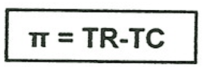
If TR > TC, positive economic profit is earned in what is known as supernormal profit. If TR = TC, normal profit is earned. If TR < TC, subnormal profit is earned. With subnormal profit, firms are in danger of leaving the industry as are not earning sufficient revenue to pay off all of their costs of production.
How does a firm decide how much to produce and at what price so as to maximise profit? This can be determined using the marginalist principle. Recall that rational consumers will consume until their marginal benefit = marginal cost, as at this point, utility is maximised. Similarly, producers will produce until the marginal revenue (MR) earned from producing one unit of a good is equal to the marginal cost (MC) of producing that unit of good. Thus, firms will price and produce at the point where MC = MR.
There are, however, limitations to the traditional objective of profit-maximisation. Firms may wish to maximise profits but are unable to do so, due to a lack of sufficient or accurate information about demand and cost conditions that exist. The larger a firm is, the less a firm is able to accurately gather data about revenue and cost conditions. The cost of obtaining sufficient information may be significantly high, and there is a problem of deciding the time period to maximise profits, as firms operate in a dynamic environment in where demand and cost conditions constantly change.
In addition, firms may choose to pursue alternative objectives beyond profit maximisation, particularly in larger firms where there are multiple departments and layers of management that may individually decide to pursue different objectives. They include, but are not limited to:
- Entry Deterrence – Barring the entry of potential new firms int the industry, such as through setting extremely low prices such that new entrants are forced to follow suit and price at a point that makes them make subnormal profit, thereby potentially forcing them out of the industry. This could also be done through aggressive advertising and brand loyalty schemes that makes consumers unlikely to switch to the products of competitors.
- Revenue Maximisation – In a situation where employers higher managers and directors to be in charge of sales on the ground, these sales-managers may be more interested in earning a higher commission for more products being sold. This leads to what is known as the principal-agent problem, where managers aim to maximise total revenue and sell as many products as possible to earn a greater commission. This output may be higher than the profit-maximising output, and thus, due to diminishing marginal returns, results in less profit overall for the firm.
- Profit Satisficing – This is behaviour in which a firm aims for a target level of profit rather than the maximum level, so that other benefits can be enjoyed such as shorter operating hours and lower levels of stress.
- Market Share Dominance – Market share is commonly measured by the proportion of the firm’s total sales revenue vis-à-vis the market. This involves expanding one’s size and influence over the market, such as through increasing output to extremely high levels and saturating the market with one’s products.
At the end of the day, profit-maximisation is certainly a relevant, overarching long-run objective to ensure firms survive and stay in the market, but it may not be the primary objective in the short-run. So, what are some considerations with respect to costs and revenue that a firm must consider, and how large should a firm get?
Costs and Revenue, Short Run vs Long Run
Firms are organisations formed by entrepreneurs who bring together various factors of production – land, labour and capital – to produce goods and services for sale. Thus, to increase production, firms need to acquire greater quantities of certain factors of production. However, this may not always be possible immediately. In the short run, firms can only increase certain inputs. In the context of a hawker, the hawker could hire new workers, buy more cooking oil, or buy a new cooking appliance – these are known as variable factors. However, there are inputs that firms cannot change in the short run – for a hawker, this could be the rental space they own and pay for in installments. These are known as fixed factors. Thus, in the short run, at least ONE factor of production is fixed, and output can only be increased by using more variable factors. However, in the long run, ALL inputs can be varied, except the level of technology, which is exogenous to the firm.
Thus, in the short run, there are fixed costs and variable costs. Fixed costs (FC) are costs that do not vary with the output level, and have to be paid even if output = 0. These include rental costs, or paying installments on a piece of machinery. Variable costs (VC) are costs that vary with output level, and when output = 0, variable costs = 0. These include the cost of raw materials, wages to be paid, or percentage tax. Thus, the total cost (TC) is the sum of all FC +VC.
Since, in the short run, fixed costs have to be paid even if the firm is producing nothing at all, variable costs become extremely significant in determining short-run pricing and output decisions. Provided that a firm is able to cover its variable costs (i.e. TR > VC), it will continue to produce. Otherwise, it will shut down production.
In the long run, since all factors of production can be varied, firms should consider the scale of production, as they have full control over their factors of production. We have previously discussed the law of diminishing marginal returns and utility – now, we will introduce the concept of returns to scale, which analyses how changing inputs would affect the change in output. There are three possible situations as follows:
- Constant Returns to Scale – Output increases proportionately to the increase in inputs.
- Decreasing Returns to Scale – Output increases less than proportionately to the increase in inputs. This is known as diseconomies of scale.
- Increasing Returns to Scale – Output increases more than proportionately to the increase in inputs. This is known as economies of scale.
Thus, in the long run, average cost (the total cost divided by the total number of units produced) will vary with the quantity of output as shown:

As output rises, the first average costs fall as the firm benefits from internal economies of scale. When the Long Run Average Cost (LRAC) is at its minimum, minimum efficient scale (MES) is achieved. This is the optimal output level beyond which no significant or additional economies of scale can be achieved. The LRAC is commonly known as a firm’s planning curve because it decides the size and scale of its plant in order to produce a given level of output at the lowest possible cost.
Why does the average cost change as the scale of production changes? As mentioned previously, this is due to economies and disceconomies of scale. We will now look at internal economies of scale (iEOS), where internal refers to the expansion and growth of an individual firm (as opposed to external, which refers to the expansion of the industry as more firms enter the market).
iEOS refers to the cost savings that occur as a result of the firm’s expansion, created by the firm’s own policies and actions. Diagrammatically, it is represented by a movement along the falling portion of the LRAC curve. There are 5 common types of iEOS:
- Technical EOS – These are gains in productivity/efficiency from scaling up production, such as through purchasing new machinery to be able to produce a larger output at a lower unit cost, or through the specialisation and division of labour as, when more workers are hired to increase output, individual workers become more productive as they focus on specific tasks.
- Financial EOS – These are reductions in the cost of borrowing as larger firms are often given lower interest rates and larger loans because of better credit ratings and greater collateral.
- Managerial EOS – By employing specialists to supervise production, there is better management of and investment in human resources, improving communication, raising productivity and reducing unit costs.
- Marketing EOS – This is when large firms are able to bulk buy supplies, and receive discounts on their purchases as they have greater bargaining power than smaller firms and are given preferential treatment.
- Risk-bearing EOS – This is when large firms are able to spread the uncertainty in the cost of production over a large level of output, thereby reducing unit costs, such as by producing a wide variety of products, or operating in many geographic locations.
However, beyond the MES, average cost increases as output increases, and the optimal level of production is exceeded. This is due to internal diseconomies of scale (iDisEOS), which refers to the increases in costs that occur due to expansion of the firm. Diagrammatically, this is represented by a movement along the upward sloping portion of the LRAC. This could be due to one of two reasons:
- High cost of monitoring and management – As a firm gets very large, monitoring the productivity and quality of output is imperfect and expensive. There is also a risk of the principal-agent problem arising as agents may have alternative objectives that shareholders and employers cannot monitor. Communication between divisions becomes more difficult, leading to time lags in the flow of information, creating problems in terms of the speed of response to changing market conditions.
- Low morale of employees – In a large firm, relationships tend to become impersonal. Workers may develop a sense of alienation and a loss of morale, which decreases productivity and efficiency.
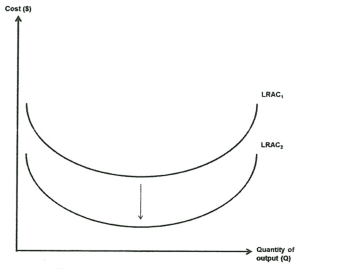
Cost and output decisions are not just decided by a firm’s own expansion, but also, the expansion of the industry. External economies of scale (eEOS) can be reaped as more and more firms join the industry, allowing individual firms to enjoy reductions in cost. Diagrammatically, eEOS is represented by the downward shift in the LRAC curve as average costs fall for each level of output, as seen below.
There are 2 main types of eEOS:
- Economies of Information – The development of R&D facilities in several firms may improve the productivity of all firms as firms can share cost-saving techniques that could improve the efficiency of business or production processes.
- Economies of Concentration/Agglomeration – This arises from the clustering of businesses in a distinct geographical location (such as software in Silicon Valley, or even hawkers under the same roof in a hawker centre). There is more skilled labour available in the same location, as well as well-developed infrastructure catered to ensuring resources are delivered to these businesses, reducing average costs for firms for transportation, and the training and hiring of workers.
However, external diseconomies of scale (eDisEOS) can certainly arise if the industry expands and becomes too large. Diagrammatically, this is represented by the upward shift of the LRAC curve as average costs rise for each level of output. This is due to one of 2 reasons:
- Increased Strain on Infrastructure – With an increasing concentration of firms in a geographical region and an expansion of productive activities, infrastructure will be taxed to its limits. With increased congestion and fuel consumption, this may lead to increased costs for all firms.
- Shortage of industry-specific resources – as an industry grows, this creates competition for resources that pushes up prices, and thus increases costs for all firms.
With this discussion about iEOS and eEOS out of the way, the question as to what a firm’s output should be and how large a firm should be remains unanswered. Why a hawker versus a restaurant? Small or large? This all depends on where MES is reached relative to market demand. In some industries, such as the hawker food industry, MES can be achieved at low levels of output, far below market demand for hawker food, as there are limited opportunities for economies of scale to exist in the hawker industry – the space a hawker has for his kitchen already limits the extent one is able to produce to. On the other hand, say, in Singapore’s taxi industry, MES is generally only achieved at high levels of output, and thus taxi operates aim to continually expand their fleet of vehicles. Thus, these are the cost-side factors that affect a firm’s output and pricing decisions in the short run and long run.
What about revenue-side factors? This can also answer the question as to why small and large firms, like hawkers and restaurants, can coexist in the same industry (food.) Small firms like hawkers can exist because large scale production is not justified by the size of the market. In terms of revenue-side factors they include:
- Nature of the product – fresh produce and foodstuffs tend to have small and localised markets as they are perishable. The products could also be specialised, and traditional, and must be made by hand, as with hawker food.
- Prestige markets – the market may be limited by its exceedingly high price, such as boutique sports car or jewellery producers. (This does not apply to hawker food. Though it is pretty presitgious in its own right.)
- Personalised services – consumers may demand individual attention, making it impossible to have mass production. Especially in the food industry where cooking and service are combined, some customers might appreciate the friendly relationship with the hawker aunties and uncles.
- Geographical limitations – if the product has great bulk in relation to value, transport costs will be high. In such cases, the market is likely to be local rather than normal (again, not applicable to hawker food.)
Having discussed the various cost and revenue factors in both the short run and long run that determine the size of a firm, we will now look at firms in relation to their industry, and the different types of industries that exist in the real world.
The Spectrum of Competition
We have come to understand that firms make decisions based on their objectives (generally thought to be that of profit-maximisation) and their cost and revenue conditions. They will also factor in the actions of their rivals, as well as the business risks and uncertainty associated with each decision they make.
The characteristics of market/industry, also known as the market structure, will significantly affect the output, pricing and non-pricing decisions of individual firms, as well as their performance, including profit levels and degree of efficiency. Market structure generally varies with the level of competition in the industry.
The following are the characteristics that determine market structure:
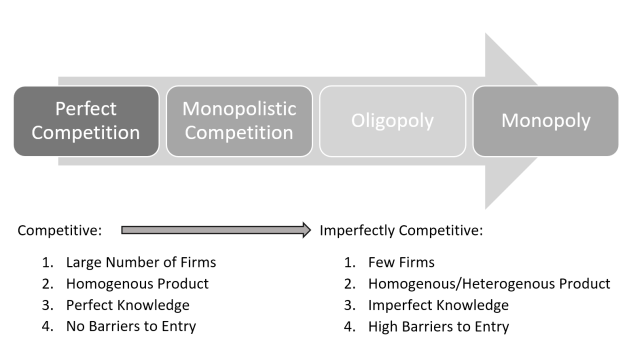
- Number of sellers/firms relative to market size – a large number of firms generally means more competition in the industry, while a small number of firms means that there is less competition as there are simply fewer competitors. This can also be measured in terms of market share.
- Nature of product – refers to whether products are homogeneous (exactly the same) or differentiated, or whether there’s just one product, versus many varieties available to consumers.
- Knowledge of product/market – Perfect knowledge means perfect competition, while imperfect knowledge generally indicates that firms are large, thus indicating less competition.
- Extent of Barriers to Entry (BTE) – BTE are conditons that prevent or impede entry of new firms into an industry, thereby limiting the amount of competition faced by existing firms in the industry.
The spectrum of competition with respect to different market structures is as follows:
 Perfect competition (PC) generally does not exist in the real world, as it is built on strict assumptions that are generally unrealistic (such as product homogeneity, or zero barriers to entry/exit). thus, it is used as a useful standard against which we can judge the shortcomings of real-world industries. Industries such as the stock market and foreign exchange market come very close to being perfectly competitive, since there is simply trading in currency and stocks. PC firms, with an insignificant market share and product homogeneity, have no control over their prices. Thus, its pricing and output combination is determined by market demand and supply. In the long run, PC firms are only able to make normal profit (TR = TC). This is because if, in the short run, PC firms make supernormal profit, these profits will be quickly eroded away as more firms can enter the industry easily due to low BTE. If, in the short run, PC firms make subnormal profit, firms can easily leave the industry, thus resulting in fewer competitors and prices being driven back up to normal levels.
At the other end of the spectrum is the monopoly. The strict definition of a monopoly is one whereby there is only one firm in the industry. In a monopolistic industry, due to the fact that the single firm essentially controls the industry, its market share is that of the entire market. Thus, it has great price-setting ability due to a lack of existing competition. The monopolist enjoys naturally high barriers to entry due to iEOS. This is because the firm is already operating on a large scale, thus enjoying substantial cost advantages that new entrants would not be able to enjoy immediately. Thus, it is able to make supernormal profit in the long run with no threat of competition. Because of this, it can afford to gain further control of the market through investing in expensive advertising campaigns or R&D.
Oligopolies are market structures in which there are few dominant firms and multiple small firms. Though there are firms in the oligopolistic market structure that have a large market share, oligopolistic firms generally do not engage in price wars due to what is known as mutual interdependence. This is a situation where firms are affected by their rival’s decisions. Rivals will change prices accordingly if a firm decides to lower prices, or will maintain prices if a firm decides to raise pries, so there will overall be a reduction in profit if a firm engages in price competition. Generally, pricing and output decisions in oligopolies are decided by the most dominant firm in what is known as price leadership. This is because, in a market of imperfect information, the market leader is assumed to have the best knowledge of the price and output combination to profit maximise, therefore, other firms will follow suit. Thus, though predatory pricing and price wars do occur in an oligopoly, price competition is generally not the preferred means of competition as losses in the short run are inevitable, so price wars are not sustainable. Thus, oligopolistic firms tend to product differentiate, either through creating real physical differences, advertising imaginary differences, or altering the conditions of sale. Oligopolistic firms may also choose to collude, the purpose of which being the reduce the unpredictability of rivals’ reactions to the firm’s pricing strategies. By colluding, whether formally or informally, firms agree to further limit competition among themselves through agreed output quotas, fixed prices, limits on the extent of product promotion or development, and agreements not to poach each other’s markets.
Finally, Monopolistic Competition (MPC), which happens to be the industry that hawkers operate in. MPC is a market structure whereby there is a relatively large number of small firms. The seller still retain a certain degree of market power as their products are differentiated, unlike firms in PC. Unlike in oligopolies, MPC firms can engage in price competition as if a firm lowers its price, its gains in sales revenue will be spread thinly over many of its rivals. Thus, the extent to which each rival firm suffers is negligible, so retaliation by rivals is much less likely. Thus, mutual interdependence is not present in MPC, as there is much less consideration of the possible reactions of rival firms. However, unlike oligopolistic firms and monopolies, MPC firms can only earn normal profit in the long run, as there are relatively low BTE present like in a PC industry.
Now that we are aware of the various types of market structure, let us finally assess the economic performance of firms in different market structures.
Assessing Performance
The performance/desirability of a market structure is assessed in terms of the impact on:
- Efficiency (Allocative, Productive, X-Efficiency, Dynamic)
- Equity
- Consumer Choice
Allocative Efficiency (AE) refers to the allocation of scarce resources that yields the right mix and quantities of goods and services to maximise society’s welfare. Generally, without market failure, AE is achieved when the price of the good is equal to the marginal cost of producing that good. Thus, AE decreases as the competition in the industry decreases, with PC firms being allocatively efficient, and all other market structures being increasingly allocatively inefficient from MPC to monopolies. This is because to profit maximise, firms price at MC = MR rather than P = MC, and since MR for imperfectly competitive firms is not equal to the market demand, imperfectly competitive firms will underproduce.
Productive Efficiency is achieved when resources are used to maximum capacity and are fully employed. This is closely related to X-Efficiency, which is when firms are producing at the lowest possible average cost at any given level of output. A firm operating above the LRAC is X-inefficient and productively inefficient. All imperfectly competitive firms are generally productively inefficient as they are not producing at the MES unless by chance, meaning that the optimal level of output is not reached.
Dynamic Efficiency refers to a firm’s ability to adapt to changes in the market, and is heavily dependent on a firm’s ability to innovate and invest in R&D. Thus, imperfectly competitive firms are likely to be more dynamically efficient as they can earn long-run supernormal profit that can help to fund ventures into innovation.
Equity, or distributive efficiency, refers to the fairness in distribution of wealth, income and opportunities. Imperfect competition generally generates inequity as supernormal profits are concentrated in the hands of a few wealthy individuals and are not redistributed to the rest of society.
Consumer choice refers to the variety of products available for consumption. In this respect, imperfectly competitive firms are able to offer consumer choice as they tend to product differentiate and innovate to create new products for consumers to enjoy.
If we look at hawker centres as an MPC industry, we can see that they are generally more Allocatively Efficient than restaurant chains, and they tend to be more productively efficient as well, especially since they are smaller and can thus better keep track of the processes in their business. There are few equity concerns given that hawkers generally cannot make long run supernormal profit, and the vast variety of hawker food on offer is a testament to the consumer choice offered by hawker centres. As for dynamic efficiency… is there room for the hawker industry to evolve?

In Conclusion…
Maybe the answer is yes, hawker centres and hawker stalls are continuously evolving and changing according to the tastes and preferences of new consumers. However, traditional hawker centres are here to stay too. Which actually perfectly sums up this post – that firms make a multitude of decisions to survive, and at the end of the day, not one firm is the same as the other, as firms in the same industry employ certain strategies to differentiate themselves and consolidate their market share so as to survive. Whether they do so to maximise profit, or to achieve other objectives, is unknown to us as consumers, but at the end of the day, it is in a firm’s best interests to survive and offer better services than its competitors. They might be hampered or helped somewhat by the market structure they exist in, and that’s just the way the cookie crumbles.
I’m excited to see what kind of a turn hawker food takes next. Maybe we might even see hawkers expand overseas, bringing something uniquely Singaporean beyond Singaporean borders for the whole world to enjoy. But then these firms will turn international, and that’s a topic for another post entirely. Till then, long live the food industry, I say.
 Discover Economics
You must be logged in to post a comment.