The old adage “save for a rainy day” suggests the importance of holding off current consumption to be able to attain higher levels of satisfaction or comfort in the future, in case of any emergency. This couldn’t be more true – many contemporary and traditional models of macroeconomic growth consider the savings rate to be an important factor in determining the growth of economies.
Yet, with the study of saving behaviour having been a central theme of economics since the days the subject was known as political economy, we are today facing an impending pension crisis in which, due to a difference between pension obligations and the resources set aside to fund them, there is predicted difficulty in paying for corporate, state, and federal pensions in the United States and Europe. As workers grow older and leave the productive workforce, their savings, in addition to pensions and other social security, are the only money they have to be able to live out the rest of their lives. Social security spending has become a hot button issue in many countries, and specifically, citizens have been arguing for increasing payouts and more benefits. In Singapore, similar protests against the Central Provident Fund (CPF), a mandatory social security savings scheme funded by contributions from employers and employees that serves to meet the retirement, housing and healthcare needs of Singaporeans, have arisen. Opponents argue that they would prefer to have full control over their income now, rather than having a portion of it being stored away only for later use.
A careful balance has to be struck between the two pans of the balance scale that are government expenditure and taxation in the case of the looming pension crisis in the West. However, where there is opposition to the CPF in Singapore, it is few and far in between as income is not taxed and redistributed per se, but merely saved on your behalf, for the rainy days of old age. What has caused the pension crisis, and why is it so important to solve? Does saving even have a measurable, positive impact on growth in the long term? Can the savings rate even be influenced by policy of our own doing? Would forced saving, as in Singapore, be the solution to the pension crisis and an ageing population? I will attempt to address these questions within this post, by which time I would be tired, old and gray.
What has caused the pension crisis, and why is it so important to solve?
There have been three reasons for the pension crisis, and in general a growing dependency ratio. Firstly, the birth rate has fallen in most developed economies. Although immigration has partially offset the effect of this in some countries, there has still been a net effect of a steady reduction in the addition of new workers. The second effect is that longevity is increasing so that people are on average living longer. For any given retirement age, this is increasing the number of retired. Thirdly, there is also a tendency for the retirement age to fall.
Why the swift resolution of the pension crisis is needed is due to concerns for the future, as the methods through which the pension crisis is resolved has an impact on intertemporal efficiency. Time is an essential component of economic activity. The passage of time sees the birth and death of consumers and the purchase, depreciation and eventual obsolescence of capital. It sees new products and production processes introduced, and provides a motive for borrowing and saving. Intertemporal efficiency is achieved when an ideal balance is met between using resources to satisfy needs and wants today but conserving resources for the future. Caring for our elderly is intrinsically resource-intensive, and requires much spending now, yet, without planning for and investing in the future, should the aforementioned demographic trends continue, it would become more difficult to continue offering a high standard of care.
Being able to develop a robust policy system to ensure that the standard of living of the elderly now and in the future is high requires much planning, and an understanding of intertemporal efficiency. I find it apt at this point to introduce the Overlapping Generations (OLG) model, developed by Paul Samuelson and Peter Diamond in the 1950s-1960s. As popular exogenous and endogenous growth models like the Solow, Romer and Ramsey-Cass-Koopmans models were taking shape, the OLG model challenged the idea of the competitive economy by introducing time in a more convincing manner. This model has the basic feature that the economy evolves over time with new consumers being born at the start of each period and old ones dying. At any point in time the population consists of a mix of old and young consumers. The lifespans of these generations of young and old overlap, which gives the model its name, and provides a motive for trade between generations at different points in their life-cycle. This evolution of the population allows the overlapping generations economy to address many issues of interest in public economics. (Myles & Hindriks)
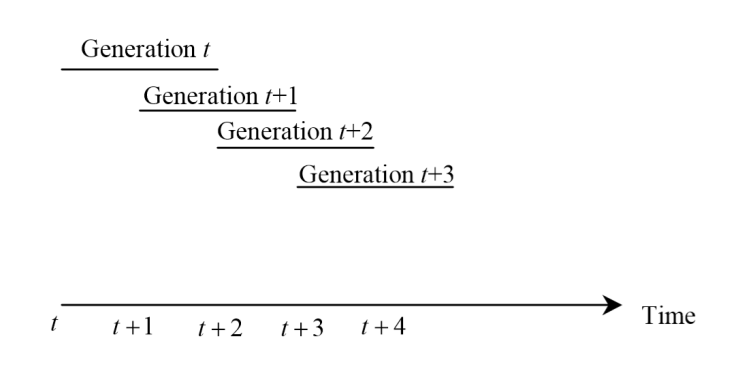
In the OLG economy, time is divided into discrete periods with the length of the unit time interval being equal to the time between the birth of one generation and the birth of the next. There is no end period for the economy, instead economic activity is expected to continue indefinitely. At each point in time, the economy has a single good which is produced using capital and labor. This good can either be consumed by the current generations or saved to be used as the capital input in the next period for the next generation.
Which goes back to the title of the blog post: can savings be used to ensure fair and sustained growth, how important is it for growth and intertemporal efficiency exactly, and can it be manipulated by policy decisions? Let us find out.
The Supposed Importance of Savings
The OLG model suggests that any capital or goods not consumed now is saved, and its accumulation allows future generations to have a greater ability to spend. Thus, savings have importance when it comes to growth in the long-term. The Solow Growth Model, a widely-accepted exogenous growth model, assumes that the accumulation of capital was crucial and central to a country’s growth rate. An increase in the savings rate results in a short term increase in growth during a country’s transitional period towards steady state growth. Old exogenous growth literature attributed to saving behaviour at most a permanent effect on the level of per capita income, but only a transitory effect on the rate of growth of per capita income.
However, I would argue that exogenous growth models adopt a relatively narrow definition of saving, which is merely abstaining from current consumption. Understanding intertemporal efficiency allows us to understand that beyond consumption and abstaining from consumption, investment is also an important choice that can be made by economic agents. A broader view of saving behaviour constitutes investment, which encompasses R&D, additions too the stock of knowledge and human capital accumulation, needs to be adopted given that technical change has become increasingly endogenised. Thus, new endogenous growth literature implies that differences in saving behaviour will have permanent effects on both growth rate and levels of per capita income. Economists such as Frankel, Romer and Lucas found it difficult to accept that the rapid improvements in technology witnessed in the twentieth century were emanating solely from outside economic activity. This is because any activity, including innovation and technical improvement, is pursued continuously only if people are rewarded for it. There is no steady state in endogenous growth models, thus an increase in savings rate would result in a permanent long run increase in output per capita.
Thus, I would argue that the savings rate is indeed important for long term growth, in the same way that investment and capital accumulation are important for potential growth. Saving allows families to prepare for rainy days, and individual thrift allows wealth to build up over generations, which has implications for younger generations, as it allows individuals to be able to take more entrepreneurial risk and have access to more opportunities. According to endogenous growth theory, economic policy has the potential to influence saving, notably social security retirement schemes, deficit finance, wage and non-wage income taxation, interest taxes, subsidies and public consumption spending, all of which are policies that do not directly force individuals to save, but can influence the behaviour of economic agents. Even if the savings rate only has a transitory effect on growth, it has the potential to increase the steady state level of growth.
One caveat, as with any policy change, is what is known as Ricardian Equivalence, which refers to the proposition that the government can alter an economic policy and yet the equilibrium of the economy can remain unchanged. This occurs if consumers can respond to the policy by making off-setting changes in their behavior which neutralise the effect of the policy change. For instance, Ricardian equivalence holds when the government introduces, say, a full-funded social security programme, and consumers respond by making a reduction in their private saving, which ensures total saving is unchanged. Thus, governments have to be careful with the policy they intend to introduce so as to effectively alter the savings rate.
We should also note how trying to alter the savings rate across the board might not be as effective in the long term growth for generations of low-income families. Where the rich can afford to save a proportion of their income, and thus their saving behaviour is more easily altered, the poor generally consume most, if not all of their income, and thus it is difficult to alter savings behaviour when they are unable to save in the first place. Should they be made to save large amounts, they will be left with too little take-home pay for their current consumption needs. However, we know that saving has the potential to bring future generations, both low-income and high-income, a higher standard of living for the future, so what can be done to prevent unequal outcomes due to savings-related policy changes?
Return My CPF! Forced Savings as the way forward?
On an individual level, CPF savings promote personal and familial self-reliance and financial protection, an economic attitude constantly encouraged by government leaders. Collectively, the CPF savings assure the government of an enormous, relatively cheap “piggy bank” for funding public-sector development; the savings also serve as a mechanism for curtailing private consumption, thereby limiting inflation. Although comparable to social security programs in some Western countries, the CPF’s concept and administration differ. Rather than having the younger generation pay in while the older generation withdraws, whatever is put into the CPF by or for a member is guaranteed returnable to that person with interest.
Singapore’s much-vaunted savings rate – and much of the funding for development, particularly public housing – resulted in large measure from mandatory contributions to the CPF, as well as voluntary deposits in the Post Office Savings Bank. The Central Provident Fund was set up in 1955 as a compulsory national social security savings plan to ensure the financial security of all workers either retired or no longer able to work. Both worker and employer contribute to the employee’s account with the fund.
This however, has created a problem of high wages. Since CPF contributions make up a fixed fraction of an employee’s wage, it affects labour costs, and also has significant fiscal policy implications, having a strong contractionary fiscal influence. Though they have certainly contributed to the high savings rate in Singapore, there have been trade-offs by way of actual growth, since consumption levels are low, as well as having much slack capacity, which though can be used to embark upon public sector projects to yield an economic return, this could result in Singapore being over-endowed with buildings, with too few productive businesses to put in them.
“If everybody then had the same (relatively) low income, there would be no saving, no investment, and no economic growth.” – Branko Milanovic
Every policy has its trade-offs, and though increasing the rate of saving has the potential to create long-term, multi-generational and accumulative growth, it may actually serve to exacerbate income inequality as only the rich have the wherewithal to save, while the poor spend everything they earn. However, policy changes are able to create behavioural changes in economic agents, and thus, can influence the rate of saving indirectly, making it an important consideration in policy design. But in addition, social security and full-funded pension schemes to support the low income should be implemented in addition to saving schemes so as to ensure that there is fairness and inclusiveness in growth, so that different families can grow under the protection of the umbrella of policies and their own savings for generations to come.



You must be logged in to post a comment.