The American Revolution in the late 18th Century saw the establishment of America’s first independent government with George Washington at its helm. There have been many references in pop culture to the Revolution, most notably the critically-acclaimed Hamilton, which follows the rise and fall of Alexander Hamilton, one of America’s founding fathers. As the Secretary of the Treasury, he was responsible for authoring many economic policies under George Washington’s administration, and he established America’s national bank.
Of course, his journey wasn’t easy. In addition to his personal life (very much outlined and sensationalised in Hamilton), his life as Secretary of the Treasury was tumultuous too – with limited information regarding the economic status of the new country, and much of the data being clouded and ambiguous, it was difficult during this “antebellum period” for him to measure exactly how the American economy was performing and where it was headed.
Robert Frank and Ben Bernanke define macroeconomics as the study of the performance of national economies and the policies that governments use to try to improve that performance. Macroeconomics as a discipline only really came to prominence after the Great Depression, when economists saw the need to measure the health of the economy as a whole. Thus, through the lens of Hamilton, we will see how macroeconomics is a discipline wholly applicable to the past, and we shall be introduced to the various commonly-known indicators of economic performance and living standards.
Economic Performance

1. Economic Growth
Economic growth refers to the increase in production of goods and services in an economy (an increase in the national product). It is important to note the following fundamental equation (the national income equation):
National Product = National Income = National Expenditure
The reason for this is simple: the monetary value of the total production in an economy would be equal to the total income earned by the workers who earn money by producing goods and services (national income). In turn, the income earned is spent by the workers (national expenditure).
Growth can be both actual and potential – both actual and potential economic growth are required to ensure sustained economic growth. Actual economic growth is the increase in national product, while potential economic growth is the increase in the economy’s capacity to produce and increase its national product.
Commonly, we can represent changes in economic through the Aggregate Demand – Aggregate Supply (AD-AS) model. AD refers to the sum of all final goods and services produced in an economy, while AS refers to the total supply of all final goods and services produced within an economy at a given overall price level.

Actual economic growth can be seen by the shift in AD from AD1 to AD2, as if the total output of the economy increases, then as per the national income equation, the total income increases (the increase in Real NY from Y1 to Y2), leading to an increase in the overall demand in the economy. Potential economic growth can be seen by the shift in AS from AS1 to AS2, as now, there is the potential for AD to continue shifting rightwards such that Real NY (national income) can increase past Y2.
One of the key indicators of economic growth is Gross Domestic Product (GDP). By definition, GDP is the value of all final goods and services produced within the geographical boundary of a country during a given period of time. GDP is typically measured in terms of the currency of the country. It is important to note the difference between real and nominal GDP values – real GDP values are adjusted for inflation and population change, and are calculated by using the prices of a particular base year, whereas nominal GDP values are calculated by using the prices that are current in the year in which the output is produced. Therefore, the most accurate indicator of economic growth would be real GDP per capita, since this measurement is not only adjusted for inflation, but the per capita (meaning per person) values can be compared across space, allowing one to compare levels of development between advanced and emerging economies.
In analysing Hamiltonian times, economists used income per capita as their measure of economic growth. As per Figure 1, economists generally agreed that in the period after the American revolution, there were major increases in income per capita. This was due to the expansion of railroads and other methods of transportation that created a period of growth, as well as the trade boom caused by the Napoleonic Wars within Europe. However, some economists argue that the major expansion into the West after America gained independence created a dragging effect on agricultural labour productivity, which decreased income per capita until the 1820s.
Therein lies problem with the use of real GDP per capita – it may not accurately measure the national output because the production of some goods and services goes unrecorded, or some figures are over-reported. During both the American Revolution and in modern times, non-market activities and the underground economy go unrecorded. In the 1800s, with paper currency only recently going into circulation, people would commonly trade services with each other or cooperate on various tasks without exchanging money. Families in these communities also tend to be relatively self-sufficient through subsistence farming. These unreported transactions may also be illegal (such as drug dealing, or crime), making GDP a possibly unreliable indicator for economic growth.
Gross National Income (GNI) is not the same as GDP, for GNI measures the value of all final output of goods and services produced by domestic factors production during a given period of time. The difference between GDP and GNI is that GNI accounts for net factor income from abroad (NFIA), which is the difference between the income that locally-owned residents/firms have received from abroad and the income claimed by nonresidents based locally. GNI would therefore show a more accurate relationship with consumption levels and growth as incomes earned by local factors are more likely to be spent in the domestic economy, while incomes earned by foreign factors would be spent overseas, and would not contribute to the growth of the domestic economy.
In 1966, Robert Gallman would publish “Economic Growth and Structural Change in the Long Nineteenth Century”, in which he chose GNP to depict growth through changes in aggregate output. He felt it was the more appropriate measurement as he believed there to be significant growth 2 or 3 decades before the civil war due to “industrialization, westward movement and the immigration of European immigrants”
Regardless of the indicator used to measure economic growth, it is clear to see that during this period, American economic growth was not sustainable. It was not until 1820 that income per capita had reached the same level as it had been before Revolutionary War, as uncertainty after the War lead to a dysfunctional financial system and disruptions to overseas trade, with large demand and supply shocks to American commodity exports. In his magnum opus, the “Report on the Subject of Manufacturers”, Hamilton would try to combat the unsustainability by imposing tariffs on imports to raise revenue to fund the nation, as well as to protect American infant industries until they were large enough to compete. Subsidies were also implemented to support infant industries and encourage the spirit of enterprise, innovation, and invention within the nation. From the 1820s onwards, it is generally recognised that there was an economic boom with a rapid increase in income per capita, a testament to the success of Hamilton’s financial plan.
However, in addition to sustainable economic growth, governments today also recognise that economic growth must be inclusive. Inclusive economic growth refers to growth that is not only sustained over a period of time, but is also broad-based across economic sectors, and creates productive employment opportunities for the majority of the country’s population. To achieve inclusive growth, income distribution must be accounted for, and growth must not worsen income inequality. This is important as, for the long-term, inequality leads to allocative efficiency and limits the potential for an economy to grow. Post-colonial America saw a lagging South – from 1774 to 1840, American income per capita grew at 0.38% per annum, and while the per annum rates for New England, 1.24, and the Middle Atlantic, 0.69, were almost two to four times that of the American average, Southern incomes fell.
Today, to track inclusive economic growth, we commonly use the Gini coefficient, developed by the Italian statistician and sociologist Corrado Gini in his 1912 paper Variability and Mutability. The Gini coefficient represents the income distribution among a country’s citizens and measures inequality. The coefficient ranges from 0 to 1 – the closer the coefficient is to 1, the more unequal the distribution of income. According to an article published by Jordan Weissmann, currently a senior Business and Economics Correspondent at Slate Magazine, in 1774, the Gini coefficient was estimated to be 0.437. By 1860, this figure had increased to 0.51. But beyond this blatant increase in inequality, there is more to meets the eye in economic performance than just economic growth.
2. Price Stability
Price stability results from a low rate of inflation. This means that prices in general do not change in a wild, unpredictable manner, which aids in the process of economic decision-making.
Inflation is a situation where there is a sustained increase in the general price level. If inflation is high, the purchasing power of money erodes quickly since the same amount of money can buy fewer goods as goods become more expensive. On the other hand, deflation refers to a situation in which the prices of goods and services fall over time, such that the rate of inflation is negative. Where inflation is typically associated with demand-driven economic growth as the prices of goods are driven up, deflation is typically associated with the contraction of an economy – this affects the confidence of investors. Disinflation refers to a substantial reduction in the rate of inflation. Governments aim for disinflation when rates are too high, thus disinflation refers to a situation in which prices are still rising, but at a slower rate.
America during the Revolutionary War saw great levels of inflation, In May 1775, the Continental Congress began making preparations for war with Great Britain, and according to William Graham Sumner, a classical liberal American social scientist at Yale University, they resolved to issue paper money to pay for salaries and supplies. Taxation was not even considered, and the few who recommended it were ridiculed or ignored. Americans were rightly averse to any taxation, but war bills had to be paid somehow. They chose to finance the war through the printing of bills of credit (paper currency receivable for future taxes). Congress would continue to crank up the printing press, and it called on the individual states to levy taxes to retire the bills. Congress could then issue a new batch of currency. The states, however, never laid the taxes. What was worse, they began issuing their own currency to match the Continental issues. The disastrous result was that all the bills stayed in circulation – Congress and the states continually printed more, and the whole mass depreciated to almost nothing in five years. The depreciation became marked and significant in the latter half of 1776, and though price ceilings for a wide range of goods and enact wage controls were being implemented, it did little to stop the rapid inflation that America experienced.
Today, a common indicator used to measure inflation is the Consumer Price Index (CPI). Established way after America gained independence, the precursor to the modern CPI began with data published in 1919 for 32 major shipbuilding and industrial centers in the US. The CPI is defined as the a measure of the price of a fixed basket of goods and services commonly purchased by a typical household. It is a weighted price index, meaning that each item in the basket is given a weight according to its importance. In the base period, the price of the basket is assigned a CPI value of 100. Changes in the prices of individual goods and services within the basket will result in the CPI value changing overall from period to period.
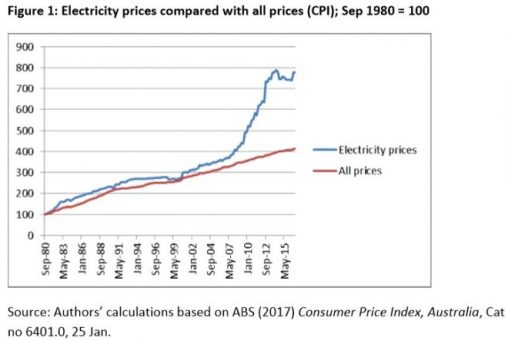
The CPI is useful as, by examining the values for individual subcategories, we can identify the sources for inflation. For instance, based on the values seen above, in Australia, we can see that the rise in all prices from 1980 to 2015 is caused in large part due to the huge increase in electricity prices, and other sources of inflation may not be as detrimental to inflation overall.
Though useful if one is purely identifying inflation/deflation, it only measures the true change in price of the reference basket of goods and services, the CPI is limited as an indicator of the cost of living. This is due, first of all, to substitution bias. This is a phenomenon that occurs when the price of a good in the basket rises – the CPI does not account for consumers who switch away from these goods to consuming relatively less expensive alternatives. These changing consumption patterns mean that the CPI does not accurately reflect the changes in cost of living from period to period, and may overstate the increase in the cost of living.
Secondly, quality adjustment bias is a phenomenon that occurs when a the price of a good in the basket rises due to an actual increase in the quality of the good. The distinction between changes in the underlying price of goods and changes in quality remains difficult to make, and thus, the increase in price is captured nominally by the rise in CPI, but the cost of living may not have actually increased since the quality of the good has increased in tandem with price.
Thirdly, new products not currently in the basket of goods may lead to consumers switching to these goods, typically resulting in them spending less to maintain the same standard of living. Thus, the CPI does not capture the reduction in cost of living attributed to the development of new products.
3. Full Employment

Full employment is defined as the full and efficient utilisation of resources. Commonly, governments focus labour when looking at full employment and unemployment rates, where unemployment of labour refers to the situation where people who are willing and able to work and are actively seeking work cannot find jobs.
After America’s independence, the creation of transportation networks such as railroads constituted the very conditions for opening new territory and breaking into areas that had virtually no transport to their name. A 300% increase in individuals employed in the railway industry was seen, and on top of that, the increased mobility lead to a 150% increase in trade employment.
Unemployment levels are estimated to have hovered roughly around 3% throughout the early 1800s. However, truth be told, until the late 19th century, the word “unemployment” didn’t exist. For America’s early settlers – and its native population – not to work was to starve. The notion of work being scarce would have seemed ludicrous to early Americans, who, after a day in the field, made their own soap, clothes and candles. It was only after Hamilton’s death that the Industrial Revolution came along, and only then did the concept of unemployment became a key part of analysing economic performance, as new manufacturing processes allowed for the formation of large companies, and the concept of doing work for commercial purposes, rather than for subsistence, became commonplace.
4. Favourable Balance of Payments Position
The Balance of Payments (BOP) is a record of a country’s international transactions, i.e. the flows of money between residents of a country and the rest of the world. The BOP can be in a deficit or surplus. A deficit occurs when a country’s residents’ spending on foreign receipts outweigh what it is receiving from the foreign economy, whereas a surplus occurs when the net inflow of receipts from foreign economies is positive. Monetary inflows into a country are called credits, while outflows to foreign countries are called debits.
Generally speaking, a favourable BOP position refers to the avoidance of large or persistent BOP deficits, or having an improved BOP surplus. To measure the BOP position, we need to break down the BOP into three components.

The first component is the current account (CA). The CA records payments for imports and exports of goods and services, plus incomes and net transfers flowing in and out of the country. The CA will thus be in surplus if the net exports are positives, and/ or if there is more money (wages, interest, profits, receipts) flowing into the country than out of it.
The second component is the capital and financial account (KA). The KA records the flows of funds in and out of a country for the purpose of acquiring or disposing fixed assets (e.g. a manufacturing plant or a plot of urban land for development), as well as the cross-border changes in the holding of shares, property, bank deposits, loans, and government securities. In essence, the KA is the overall balance of all capital and financial transactions across borders.
The main forms of investment that contribute to the KA are, first of all, foreign direct investment (FDI). FDI occurs when a foreign company invests money from abroad in one of its branches or associated companies in a domestic market. FDI can flow into a country, as well as flow out of a country of local companies invest in markets overseas. Second of all, portfolio investment refers to the holding of paper assets, such as stocks and bonds. Where FDI is known as long-term capital or fixed capital investment, portfolio investment is known as short-term capital or hot money, since portfolio investments flow quickly in and out of the country depending on interest rates and investor sentiment for investors to make a quick buck, whereas FDI is a more-than-temporary commitment to investing in a country.
The last component is the official reserves account (ORA). It records international transactions made by monetary authorities specifically for the purpose of managing the balance in both the CA and KA. It is also known as the foreign exchange reserves, and essentially ensures that the BOP remains in a favourable position by supplementing deficits in the CA or KA.
Around 1800, something like ten to fifteen per cent of U.S. output was exported, with 60% of the exports destined for Europe. However, the imports of merchandise almost always exceeded exports at the beginning of the nineteenth century. The negative trade balance was more than offset by large freight earnings, but the US had negative net balance on account of other services, such as insurance and interest. Mira Wilkins, Professor of Economics at Florida International University, estimates that America’s long-term obligations in 1803 were $65-70 million or more, including foreign holdings of federal debt and corporate stock. The current account was certainly in deficit during Hamiltonian times, explaining why import tariffs and export subsidies were strategies Hamilton decided to employ.
Living Standards

Economic performance is measured, primarily, by the 4 indicators: economic growth, price stability, full employment, and the balance of payments position. However, at the end of the day, the ultimate reason for ensuring economic performance is to raise living standards and levels of welfare. Standard of living (SOL) refers both to material and non-material SOL.
1. Material SOL
Material SOL refers to the quantity of goods and services consumed by the average person in the economy in a given time period. As previously mentioned in the section on Economic Growth, the real GDP per capita is an indicator that can be used to measure the average value per person of all final goods and services produced within the geographical boundary of a country during a given time period, adjusted for inflation. Thus, it can be used to assess the material SOL since it measures how may goods and services each individual in the economy will be able to consume. However, the problem with using this indicator to measure material SOL is that it does not account for income distribution. The distribution of goods and services to consumers is unequal and inequitable, and thus, the higher the Gini coefficient, the less we can trust real GDP per capita as a measure of material welfare.
2. Non-Material SOL
Where material SOL refers to the quantitative aspects of welfare, non-material SOL refers to the qualitative aspects, including health, stress levels, education and security among other aspects.
Real GDP per capita may function as an indirect proxy for non-material welfare, as the rise in average income levels allow consumers to enjoy more goods and services, thereby enhancing their non-material welfare. However, there are certainly sources of tension between GDP growth and non-material welfare – if real GDP growth comes at the expense of working longer hours, less leisure time is available for family or for cultural and educational pursuits, thereby compromising non-material welfare.
In antebellum America, Robert Fogel, winner of the 1993 Nobel Memorial Prize in Economic Sciences, discovered a significant decrease in the life expectancy of American-born white males (again, a testament to the availability, or lack thereof, of data at the time). This could have indicated a decrease in the non-material SOL. However, Fogel also notes that the average height for American-born white males had actually been mostly consistent during the antebellum period. Height is strongly tied to non-material SOL, since taller citizens usually indicates healthier diets, and the ability to have healthier diets, which connects to higher wages and income.
It can be seen that welfare indicators are highly limited – be it life expectancy, literacy rates, pollution standard indexes, stress levels or crime rates, the fact is that welfare cannot be quantified. Using multiple indicators in conjunction can provide a better, more holistic picture of the non-material SOL in a country. For instance, if all indicators of healthcare suggest improvements, it is likely that the country is indeed experiencing better healthcare.
This is where composite indicators come in. Composite indicators combine material and non-material measures to give a more complete picture of the level of human well-being. One of the most common composite indicators is the Human Development Index (HDI), which includes measurements of life expectancy at birth, mean years of schooling for adults and expected years of schooling for students, and also the purchasing power parity-adjusted real GNI per capita.

Hamilton lives on in popular culture due to the Broadway musical that brings to light his legacy. And just as how his story continues to evolve, be told and be interpreted, the various key economic indicators that Hamilton himself used continue to develop. As Treasury Secretary, the economic performance of antebellum-period America and her living standards were on the forefront of his mind, and even today, governments face many macroeconomic problems similar to what Hamilton faced. In the words of Okieriete Onaodowan, “he took our country from bankruptcy to prosperity”, and today, art imitates life as we continue to tell Hamilton’s story. For life to imitate art and the work of Hamilton, governments must continue to draw on the various key economic indicators available to them, and make informed decisions so that they can tell the macroeconomic story of their country.
 Discover Economics