You’ve seen it before – you stop to pay for your groceries at your neighbourhood NTUC, when behind the cashier, rows and rows of disfigurations, bloodshot eyes and blackened teeth menacingly stare back at you. These are the various visual warnings plastered across cigarette packs, as mandated by law, and is but one measure through which the government advises against the consumption of cigarettes.

But of course, everyone must have the ability to choose, no? Which is why cigarettes in many stores (despite recent legislation) remain prominently displayed in full view of the customer, such that consumers may choose their preferred brand, make their purchase, and leave about $20 poorer.
The beauty of the free market is said to be that, by the invisible hand, resources will be efficiently allocated such that societal welfare is maxismised. However, in practice, markets sometimes fail to allocate resources efficiently, and to achieve social goals like equity. When this occurs, we call it market failure, and when the market for a particular good or service fails, it results in the over-allocation or under-allocation of resources relative to the socially efficient level. For instance, there is arguably and over-allocation of resources towards the production and sale of cigarettes, since there are societal problems with respect to the over-consumption of cigarettes leading to higher lung cancer rates, or complaints by residents about individuals smoking in residential areas. We will thus explore the various sources of market failure.
Strictly by definition, since market failure is the failure of the market to efficiently allocate resources, then ideally, market failure would not occur when the price of the good is equal to the marginal cost of production/consumption, or when allocative efficiency is achieved. In other words, allocative efficiency is achieved when the value society places on the last unit of the good (price) is equal to the opportunity cost in terms of resource used in producing that last unit (marginal cost)
From this, we can derive another framework through which to understand how allocative efficiency is achieved – under allocative efficiency, the aggregate of all consumers’ marginal private benefit (MPB) can be represented by society’s marginal social benefit (MSB), while the aggregate of all producers’ marginal cost can be represented by society’s marginal social cost (MSC). Thus, under the MSB/MSC framework, allocative efficiency is acheived when MSB = MSC.
There are seven main sources of market failure
1) Externalities
Externalities occur when some of the costs or benefits associated with the production or consumption of a good “spills over” onto third parties (parties who are not directly involved in the buying or selling of the good)
Out of self-interest, the individual buyer/seller of the good does not account for these external costs/benefits. This thus creates a divergence between the MPB and MSB/MPC and MSC.
Thus, when the market fails due to externalities, MSB and MSC are no longer aggregates of MPB and MPC – the external benefits/costs, in addition to the private benefits/costs, make up the social benefits/costs. There are negative externalities of production and consumption, which arise due to the overproduction/overconsumption of a good that is undesirable and causes third-party harm, as well as positive externalities of production and consumption, which arise due to the underproduction/underconsumption of a good that is deemed desirable and actually helps third parties.
An example of a good that generates negative externalities in production is the production of chemicals. The chemical producer weighs his own costs (purchasing materials and machinery) against the potential benefits (earning a profit) of chemical production, and does not consider the external costs to third parties who are not involved in the production or consumption of chemicals. For instance, the waste produced by chemical factories pollutes rivers, poisoning the water source of local communities, and affecting the health of innocent people.
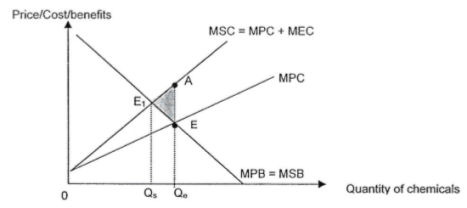
This leads to a divergence in the MSC and the MPC, as the producer is not accounting for these external costs, so the cost to him privately is less than the social cost. Thus, the market has failed as the allocatively efficient point, where MSC = MSB at Qs, is lower than the equilibrium level of consumption, where MPC = MPB at Qe. Thus, to correct the market failure, the production of chemicals must be reduced.
As per the comic featured prominently alongside the title of this blog post, negative externalities in consumption can be exemplified by the overconsumption of unhealthy foods. The individual consumer will weigh the personal costs (feeling bloated and heavy after eating the food) against his personal benefits (the satisfaction gained from eating the food), and he will not consider external costs to third parties, such as the increased dissatisfaction of his co-workers when he comes back to work after lunch being sluggish and unproductive.
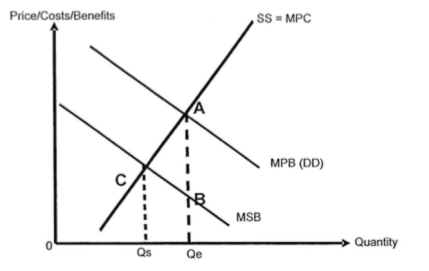
This leads to a divergence in the MSB and MPB, as the consumer is not accounting for the external costs to third parties. Thus, overconsumption has occurred, as the socially optimal level of consumption is where MSB = MSC (SS) at Qs, while the equilibrium level of consumption is where MPB = MPC at Qe. Thus, to correct the market failure, the consumption of unhealthy food must be reduced.
Where negative externalities lead connote overconsumption, positive externalities connote underconsumption, since individuals do not account for the external benefits to third parties – these goods are deemed desirable and thus, ought to be consumed more.
Positive externalities of production can be exemplified by looking at the market for engaging in research and development. The producer would only weigh his private costs (the capital needed to invest in R&D) against his private benefits (the ability to increase output in the long term), and he would not account for the external benefits, such as the benefits of the widespread adoption by society of the new technology developed by such R&D. Thus, the social costs of such R&D are lower than the private costs.
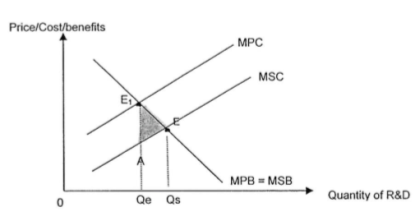
This is represented by a divergence in the MPC and MSC. Thus, the equilibrium level of production, at MPC = MPB, is at Qe, which is lower than the socially optimal level of production, at MSC = MSB, which is at Qs. Thus, the product is currently being underproduced, and increasing production would lead to the realisation of external benefits for third parties
The final externality would be positive externalities of consumption. Again, as per the title comic, a good where positive externalities of consumption may exist would be in the consumption of reduced-sugar foods. The individual will weigh his private costs (the monetary cost of purchasing the food) against his private benefits (feeling more awake and less lethargic overall). He will not consider the external benefits to third parties, such as the increase in the output of the business he works for if he falls sick less often.

Thus, there exists a divergence in MPB and MSB due to the external costs that are not accounted for. Healthier, reduced-sugar foods are thus underconsumed at Qe, where MPB = MPC, and ideally, they should be consumed at Qs, where MSB = MSC.
These 4 types of externalities represent one kind of market failure that can occur due to the existence of external benefits/costs not accounted for by the individual decision-maker.
2) Merit and Demerit Goods
Merit and Demerit Goods are goods that the government deems to be inherently desirable/undesirable to society. This market failure occurs due to the government taking on a paternalistic role, placing a value on the desirability of goods. Merit goods are necessarily being underconsumed/underproduced, while demerit goods are being overconsumed/overproduced.
Merit goods may be considered desirable for three main reasons:
- Imperfect Information: Consumers undervalue these goods as they do not know of, or underestimate the benefits of these goods. For instance, an individual may not be fully aware of the benefits of vaccination, and thus would choose not to get vaccinated as the private benefits to him are outweighed by the private costs. Thus, vaccinations are underconsumed.
- Excessive Income Inequality: An individual who is less well-off may have a desire for vaccinations, but cannot express or signal that desire as he has insufficient dollar votes to have any impact on market demand. Thus, the good is underconsumed as some individuals do not have the ability to pay for and consume the good.
- Positive Externalities: Merit goods may be inherently desirable because their consumption produces external benefits to third parties. However, in the pursuit of self-interest, individuals do not consider these external benefits, and thus, the good is underconsumed.
Demerit goods may be considered undesirable for two reasons:
- Imperfect Information: Consumers overvalue these goods as they do not know of, or underestimate the costs of these goods. Alternatively, they may overestimate the private benefits of consuming these goods, and ultimately, overconsume these goods.
- Negative Externalities: Demerit goods may be inherently undesirable because their consumption leads to external costs borne by third parties. However, in the pursuit of self-interest, individuals do not consider these external costs, and thus, the good is overconsumed.
3) Public Goods
Public goods, like merit goods, are goods that are deemed inherently desirable for society. However, unlike merit goods, where underconsumption occurs, the market failure for public goods arises due to non-provision, as they are difficult to provide commercially through the marketplace by private firms. This is due to two factors.
- Non-excludability: It is impossible to exclude non-payers form consuming public goods once it is provided. For instance, those who might not pay taxes would still have access to street lighting, and it is impossible to exclude non-taxpayers from using and enjoying street lighting. Thus, no rational consumer would choose to pay for a good in which there is a possibility of consuming it for free. This is known as free-ridership. When many people become free riders, firms will not provide the good as they will not receive any payment or revenue from providing the good, so its provision by firms is not profitable. Thus, there is a non-provision of the public good due to non-excludability.
- Non-rivalry: A good is non-rivalrous if the consumption of the good by one person does not reduce the quantity and quality of the good available to the next person. For instance, one person using the street lights to illuminate his path does not reduce the quantity or quality of lighting for the next user. Since the marginal cost of consumption of the good is zero, and since the allocatively efficient level of production is where Price = Marginal Cost, a public good would never be produced at the allocatively efficient level by a private firm, since a firm would never price a good at zero dollars. Thus, the market fails as the public good is not provided at the allocatively efficient level.
4) Market Dominance
Market imperfections arise when the market structure departs from perfect competition. When one or a few firms dominate the market, there is a departure from perfect competition, as profit-maximising monopolists set the price at a point that maximises profit, leading to an underproduction of goods.

Based on the diagram shown, the profit-maximising point for the dominant firm would be at where MC = MR, and thus, the price set is P2, leading to an equilibrium quantity of Q2. This is less than the allocatively efficient quantity, where MC = AR at Q1. Thus, market failure arises due to market dominance.
5) Information Failure (Imperfect Information)
In perfect competition, we assume that consumers, producers and all stakeholders have perfect knowledge of their costs and benefits. However, in the real world, there is a great deal of ignorance and uncertainty – imperfect information prevents economic agents from consuming/producing at levels they would otherwise choose.
Imperfect information may arise due to the goods being merit or demerit by nature. Individuals may not be fully aware of the full extent of the costs/benefits of consuming a good.
Imperfect information may also arise due to persuasive advertising. By giving potentially misleading information about the benefits of a good, this may lead to a higher than socially optimal level of consumption.
The final form of imperfect information can come in the form of asymmetric information, in which one party in the transaction (either the buyer or the seller) knows more than the other. There are two major asymmetric information problems:
- Adverse Selection: This comes about when the seller knows more about the attributes of the good than the buyer, thus the buyer runs the risk of being sold a good of low quality. Due to the lack of information regarding the accuracy of price as an indicator of quality, the buyer would hazard an average price between the highest and lowest prices. In the market for used cars, for instance, this drives sellers of good quality used cars out of the market, as they would not accept such a low price, while low quality cars stay in the market – this thus leads to market failure as the sale of low quality cars only means that societal welfare is not maximised.
- Moral Hazard: Due to imperfect information, economic agent will take greater risks than they normally would, because the costs that arise would not be borne by the economic agents themselves. For instance, in purchasing health insurance, the consumer may take more risks with his health knowing that the provider of the insurance would bear the cost. Being riskier in one’s consumption does not maximise societal welfare.
6) Immobility of Factors of Production
Factor inputs may be slow to respond to changes in demand or supply, leading to large price changes due to shortages and the inability to meet sudden changes in demand. There are two types of immobility:
- Occupational Immobility: This occurs when there are barriers to the mobility of FOPs between different sectors of the economy, leading to factors remaining unemployed, or being used in ways that are not productively efficient. For instance, if there is a sudden surge in demand for lawyers, it is difficult to immediately hire lawyers if there is a small pool of lawyers. It’s even more difficult to hire workers from other fields, and require them to learn the law. Occupational immobility implies that there is a mismatch between the skills on offer from the unemployed and those required by employers (also known as structural unemployment). Computing technology may be programmed for one purpose, but cannot be immediately re-purposed for another job when the demand for that job or that skill surges.
- Geographical Immobility: The time lag for FOPs to physically move from one location to another also leads to unemployment and allocative inefficiency, as waiting for new FOPs to arrive represents stagnating growth of output.
Both of these types of immobility represent an unemployment of resources that arises due to the time needed for the require FOPs to actually reach the industry in which there is a surge in demand. Thus, there exists allocative inefficiency, and the market fails.
7) Excessive Income Inequality
As talked about earlier with merit goods, some individuals may have the desire to consume goods, but do not have the dollar votes to signal their intentions. Thus, certain goods that are inherently desirable are underconsumed.
Inequality could be caused by competition and the principle that wages are paid in accordance with demand – individuals who receive higher wages tend to be high-skilled and are in high demand, while those with lower wages tend to be in work that is low-skilled, and there is a high supply of such workers that exceeds demand.
Inequality could also be caused by the existence of monopolies – the surpluses gained by producers are held in the hands of the rich, and those who own the companies, and such welfare surpluses are not redistributed to consumers or the rest of society.
Finally, inequality could be caused by factors like inequality of access to education, or due to globalisation, as the pressures of global competition leads to countries and employers having to adopt more flexible labour polices with no long-term commitment between employer and employee. Wages may also become more competitive and lower in a global environment.

The allure of attractive packaging works in favour of the producer, the thought of salty, savoury mid-day snacks appeals to the consumer, but at the end of the day, we know some purchases are better for us than others, the question is whether we’re fully conscious of the decisions we make (as consumers), and whether we fully understand the consequences of our production (as sellers). Market failure occurs for the seven reasons as listed above – understanding these reasons allows us to work towards creating a more efficient free market – we will discuss this in the next blog post.
 Discover Economics
You must be logged in to post a comment.