During his first inaugural address as the 32nd President of the United States, Franklin D. Roosevelt would famously say “the only thing we have to fear is fear itself”, declaring war on The Great Depression and effectively making a commitment to restoring business confidence. “We are stricken by no plague of locusts”, he would say later on in his address, implying that business downturns were far from supernatural – they had a root cause in a loss of confidence, and thus, it was found to be necessary at the time to restore said confidence amidst economic uncertainty. That commitment, in itself, was ironically a decision made under great uncertainty, a bold proclamation aligned with Keynesian theory that went against Classical schools of thought, so much so that even Roosevelt himself would admit that he was going out on a limb. “The country demands bold, persistent experimentation”, he would say, “it is common sense to take a method and try it: if it fails, admit it frankly and try another. But above all, try something.”
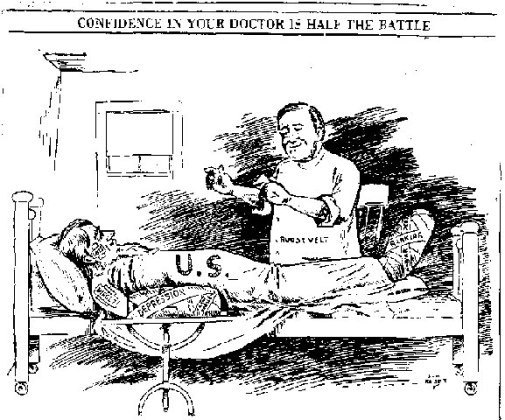
A world of perfect information is certainly an ideal world, a world that does not exist. The very notion of confidence implies that behaviour goes beyond a rational approach to decision-making, and this is logical, given that purely rational decision-making requires individuals to have perfect knowledge regarding personal and social costs and benefits, as well as to have complete, transistive, stable and context-independent preferences. Thus, not only are individuals flawed – our preferences tend to be incommensurable, but markets are arguably flawed too, and the combination of market uncertainty and information asymmetry, as well as our attitude towards risk, leads to misleading incentives and potentially sub-optimal outcomes. Yet, there does seem to be room for risk and uncertainty in the world, as well as imperfect information, since humanity has come so far knowing so little. We will thus examine how uncertainty, risk and asymmetric information affect incentives and optimal choices, as well as the counter-measures that can be taken to improve efficiency, or whether counter-measures are ever needed at all.
“The risks in our lives may not be risks we want to hold, as the apples that fall in our orchards may not be the fruit we want to eat.” – John Kay
Uncertainty is a condition under which it is impossible to list all possible outcomes or to assign probabilities to each outcome. The world is inherently uncertain, and so are economic markets. The reason for this is that information is imperfect – in the spirit of Christmas, we have no information as to the existence of Santa Claus, nor do we have information as to his non-existence (or her non-existence. Information regarding Santa Claus’ gender is imperfect as well). Thus, the conditions under which Calvin chooses to believe Santa Claus exists (as per the opinion he’s stated in the comic) are uncertain, because of the “inherent, absolute unpredictability of things” given imperfect information, as suggested by Frank Knight.
In economic markets, the exact results of human activity and decision-making cannot be anticipated, since there exists imperfect information with regards to their outcomes. So how then do individuals make optimal choices in a market, if every decision made under uncertainty is a gamble? Mathematically, the answer lies in the weighing of Expected Values.
The Expected Value (EV) of any decision is the sum of all possible outcomes of a decision, weighted by the respective probabilities of the occurrence of each outcome. The EV of a decision is an important property of any gamble (a gamble being a decision made under uncertainty, as opposed to decisions with sure outcomes) – by comparing the EVs of different decisions, one is better informed and can better choose to make the decision that will likely benefit him/her more. For instance, let us assume a scenario in which a person can choose to work in a job that earns him a monthly $5000 fixed salary (a sure outcome), versus a job in which there is a 40% chance to earn a $2500 salary and a 60% chance to earn a $7500 salary each month (a gamble). The EV of the first job would be $5000 x 1 = $5000, since he has a 100% chance of earning $5000 a month, while the EV of the second job would be $2500 x 0.4 + $7500 x 0.6 = $5500, which is a higher EV than the first job.
Thus, understanding the concept of Expected Value allows us to quantitatively compare the relative benefits of gambles. However, such a purely logical comparison does not reflect the real world, for merely comparing EVs ignores an individual’s assessment of their Expected Utility.
Where uncertainty is an imperfection in economic markets, risk and attitudes towards risk are imperfections in economic agents, i.e. individuals like you and me. Risk is a condition under which the decision maker can list all outcomes and assign probabilities to each one. The varying attitudes of an individual towards risk will result in variations in the individual’s valuation of relative expected values (EVs), since now, he also weighs the EVs of different outcomes against his expected utility (EU).
Where EVs simply shows us the monetary, quantitative value of an outcome, EUs show the relative satisfaction or happiness derived from a good/service/money to that individual, meaning that the EV of a particular outcome could be of a different utility to different individuals.
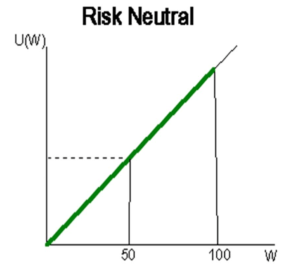
There are three broad attitudes towards risk, and individuals can be classified into these three categories: Risk-Neutral, Risk-Averse and Risk-Loving. The difference in attitudes generally stems from differences in the capacity to bear risk – the richer we are, the better place we are to face the risk of a given loss. The first is Risk-Neutral, or the ideal individual that is rational and calculative, for he will only make decisions based purely on the relative expected value, regardless whether the decision is a gamble or has a certain outcome. The only question the Risk-Neutral individual asks himself is whether the decision will yield a profit on average, and to him, any increase in wealth due to the decision results in a proportionate increase in utility – utility increases at a constant rate. Thus, his expected utility is equal to the expected value of a decision
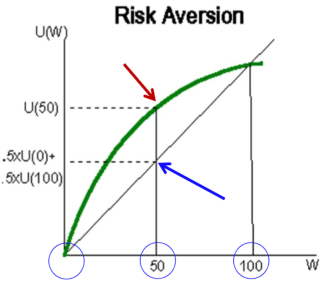
Risk-Averse individuals generally prefer a sure outcome to a gamble, meaning that even if a mathematical calculation of EV shows that the EV of a gamble is higher than the EV of a sure outcome, depending on the extent of the aversion, they may choose the sure outcome over the gamble. Risk-averse persons will always refuse both fair and unfair gambles, where fair gambles are gambles that are expected make the person no worse or no better off (EV = 0), and unfair gambles are gambles that are expected to make the person worse off (EV < 0). Thus, to risk-averse individuals, there is a diminishing marginal utility with every unit increase in wealth, meaning that they have a concave utility function in which utility increases at a decreasing rate as income/wealth rises. The extra utility earned by earning a given amount is less than the utility sacrificed in losing that amount (status-quo bias / loss aversion, anyone?). Let us exemplify this: suppose there’s a situation in which an individual can either surely earn $50, or he can choose to gamble, and have a 50% chance of earning nothing, or a 50% chance of earning $100. In this scenario, the EV of either decision is the same, $50. The risk-neutral individual would be fine with making either decision. However, the risk-neutral individual finds that the expected utility of the gamble is lower than the expected utility of the sure outcome, since the utility from earning the first $50 (so that wealth increases from $0 to $50) is more than the utility from earning the second $50 (so that wealth increases from $50 to $100), as seen from the diagram below. Thus, the risk-averse individual will choose the sure outcome over the gamble.
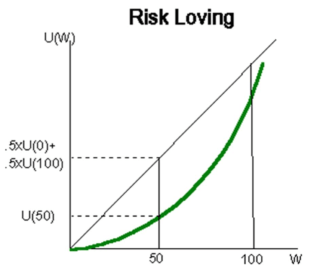
Risk-Loving individuals, on the other hand, will prefer the gamble to the sure outcome. Thus, these individuals experience an increasing marginal utility of income/wealth, and have a convex utility function, meaning utility increases at an increasing rate. They will bet on gambles even if the EV of the gamble is less than the EV of the sure outcome. Again, drawing on the previous example, even thought the EV of both outcomes is the same, the utility from earning the first $50 (so that wealth increases from $0 to $50) is less than the utility from earning the second $50 (so that wealth increases from $50 to $100), as seen from the diagram below. Thus, the risk-loving individual would choose the gamble in the hope of earning the $100 so as to increase his utility even further.
So, markets are uncertain, and individuals have different attitudes towards risk. What implications does this have with regards to incentives and optimal outcomes? Incentives, which are motivators that drive agents towards performing a certain action and pursuing one’s preferences, are affected as the indicators that drive economic actions now become more unclear. Depending on the confidence of the agent and the uncertainty regarding the conditions of the decision, this leads agents having more or less of an incentive to pursue a particular decision. An airline has an incentive to fill up as many seats on the plane as possible so as to maximise profit by maximising total revenue. However, due to uncertainty regarding how much each passenger is willing to pay and the volume of passengers intending to fly in a given period of time, airlines may have less of an incentive to fill a plane, compared to, say, striking a balance between filling seats and obtaining good prices for seats. On the other hand, passengers have an incentive to obtain cheap seats on a flight, but more importantly, they have an incentive to be able to board a flight in the first place, and the uncertainty regarding the relative prices of different airlines, or any hidden costs along the way, means that travelers may have a greater incentive to take a risk on choosing an airline even when costs are uncertain, just so that they can get from point A to point B.
There thus appears to be an issue of “incentive compatibility”, in the words of John Kay, since risk and uncertainty incentivises airlines not to fill their seats so as to obtain higher prices, while passengers are incentivised to try and get a seat on a plane. This could lead to sub-optimal outcomes in which there is an arbitrary shortage of plane seats. Sub-optimal choices would also be made – a passenger who may be more risk-loving, in a market where the costs of flying are uncertain, may actually be worse off given that he could have done his research to have found better, more certain outcomes, rather than taking a gamble on an uncertain outcome that may end up costing him more, whether in money or in safety.
Risk and uncertainty thus distort economic markets such that the incentives of various economic agents become misaligned, leading to sub-optimal outcomes, as well as individuals making sub-optimal choices – the market fails. Uncertainty and information will be dealt with later, when we take a look at asymmetric information. For now, how should we deal with risk, so that at least from the point of view of the agent, optimal choices can be better made, i.e. what counter-measures are there so as to make risk-averse individuals more open to gambles, and to have risk-loving individuals make less risky choices?

The first method to deal with risk is insurance. Insurance is a means of protection from financial loss. In the case that a decision is made, and there is a chance the decision may lead to less-than-optimal outcomes (say, if I purchase a house, there is a risk it may catch fire, or if I eat more hamburgers, there is a risk a die earlier [or is this less-than-optimal?]), insurance results in monetary payouts in the case of these sub-optimal outcomes.
How are the amounts for these monetary payouts decided? Since risk refers to a situation in which probabilities can be assigned to every outcome of a decision, a premium can be charged and calculated, based partially on the probability of the outcome occurring. Actuaries calculate the values of these premiums such that insurance companies are able to make a profit, while still being affordable enough such that risk is diluted via phenomena known as risk-pooling and risk-sharing.
Firstly, insurance leads to risk-pooling as the premium for a particular outcome is calculated from the aggregate of multiple independent risks. Different individuals will see that they have different chances of seeing a particular negative outcome occurring. Looking at fire insurance for homes, the risk-loving individual will tend to be less vigilant about fire safety in his home, and may take more risks that could lead to a higher tendency for fires to occur, such as playing with firecrackers, or overcharging his electronics. Thus, for this individual, if insurance premiums had too high of a cost, he would not feel that the cost of having a fire accidentally started would be sufficiently offset by the insurance payout, and he would thus only pay low prices for insurance. Whereas, for risk-averse individuals, there is less of a chance for fires to occur in their homes, since they take more precautions with regards to, say, leaving appliances unattended, or making sure they always through away potentially flammable materials. Risk-averse individuals would value the cost of an insurance premium over the cost of losing personal property, thus, they are willing to pay higher prices for insurance premiums. By aggregating independent risks from multiple individuals, it allows for insurance companies to be more certain about the aggregate risk involved in a particular outcome, due to the law of large numbers, where for a large group of individuals buying a particular premium, the frequency of payout becomes more stable and predictable. Thus, individuals facing independent risks can reduce their joint risks, and the prices of premiums are set a such a price that risk-loving individuals may choose to curtail their risky behaviour given the lower price of the premium, while risk-averse individuals feels safer and get a better price on premiums, and are rewarded for not taking risks, such that insurance companies don’t pay out as often.
Secondly, insurance leads to a risk-spreading effect from the insurer’s point of view. This works by reducing the stake of the insurer – the cost of an adverse outcome is too high to be borne by a single firm. By purchasing insurance from multiple sources and with different insurance firms specialising in the payout of a certain type of risk or particular scenario, the cost of an adverse outcome to each firm is greatly reduced.
By pooling and sharing risks, all individuals become protected from risk, as insurance allows individuals to deal with many risks at affordable premiums. Risk-averse individuals are rewarded for less risky behaviour, while risk-loving individuals may alter their behaviour in response to the valuation of the payouts given should they perform risky actions. By incentivising less risky behaviour, and having a system in which the cost of providing such incentives is spread across multiple insurers, optimal outcomes can be achieved.

The second method to deal with risk is diversification. As the age-old adage goes, “don’t put all your eggs in one basket” – diversification is the real-life manifestation of this, and it is a strategy of reducing risk by risk-pooling across several assets whose individual returns behave differently from one another. Where insurance helps the risk-averse individual feel safer in the face of risk, diversification can help the risk-loving individual avoid catastrophic losses. The idea of diversification is that, rather than investing in only one risky share, people can consider balancing their portfolio with a portion of safe assets and risky assets. This reduces risk overall without altering the average rate of return, thereby reducing the variability of returns. In doing so, individuals will be able to reach more optimal outcomes. They also have a greater incentive to invest in shares and make decisions that may have a lower payoff but tend to be safer, which offers greater predictability and less uncertainty in markets.
Speaking of markets and uncertainty, let us now look at methods to deal with both uncertainty and risk. We now move into the realm of information, and look at the third method to deal with risk and uncertainty, which is developing efficient asset markets (EAM). EAM theory states that the stock market is a sensitive processor of information, responding to new information to adjust share prices. As John Kay suggests, ‘market efficiency’ in risk markets takes on a different meaning – it describes how the market assimilates information about the risks which are being traded. Prices in EAMs correctly reflect prospective dividends and risk characteristics as all relevant information is immediately incorporated into share prices, thus, the free market in shares will guide society’s scarce resources towards the right firms to invest in. The provision of information through the analysis of asset markets reduces uncertainty in other free markets, and ensures market efficiency due to the smooth assimilation of information.
The fourth method in dealing with risk and uncertainty is hedging in forward markets. As opposed to spot markets, which deals in contracts for immediate delivery and payment (such as day-to-day transactions for necessities), forward markets are markets in which contracts are made today, for the delivery of goods at a specified future date. Forward markets are where hedging takes place, in which risk is shifted to another party as the buyer sets a price that is agreed on in the present. In forward markets, there would be uncertainty as to fluctuations in the price, or in the quality of a good, as time progresses after the contract. Hedging reduces this uncertainty as the good is sold in advance with a risk premium. This allows the buyer to be more certain about a purchase as the price now reflects the risk involved, shifting the risks to the seller, while the seller now has a chance to make profit via the risk premium charged.
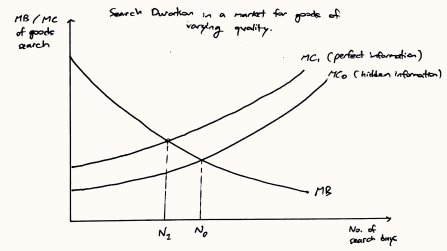
All four methods are all well and good, but as with any counter-measures regarding information, or the assessment of multiple options, there would be time involved. This is where we may employ George Stigler’s Optimal Search Theory. Stigler’s Theory was originally created in response to better understanding risk in the labour market, the idea being that, in the absence of perfect information regarding the wages of different jobs and the requirements of different jobs, we as prospective employees may need to search to find the best deal. In reality, information is scarce and costly to obtain, and acquiring information will entail search costs, though, if one is able to find a better job by searching, it would definitely yield economic benefits. Thus, in an imperfect market, the market equilibrium wage will not be characterised by a single wage, but by a distribution of wages whose variance is related to the cost of searching for info. People may find it too costly to seek out all possible information so as to eliminate wage variability, thus there exists an optimal search length, at which the marginal cost of searching is equal to the marginal benefit of searching. The marginal cost of searching is affected by two costs, namely direct costs (transport, printing resumes) and indirect costs (such as the opportunity cost of potential earnings sacrificed for search time). Reducing uncertainty and providing information would thus lead to a reduction in the marginal cost of searching, which incentives people to search for the best jobs that offer the most attractive wage, and overall, reduces the time taken searching. Thus, the job market becomes less risky and uncertain, and leads to better outcomes for prospective job applicants.
“Information is a beacon, a cudgel, an olive branch, a deterrent–all depending on who wields it and how.” ― Steven D. Levitt
Uncertainty in economic markets, as we earlier established, arises due to a lack of information. However, a lack of information can manifest itself in a more dangerous form – when there exists an imbalance, an information asymmetry.

Information asymmetry is present when one party to a transaction has more or better information than the other party. This creates a imbalance of power in transactions which can sometimes lead to sub-optimal outcomes due to a misalignment of incentives, since it makes it more difficult to make accurate decisions when conducting transactions. Such asymmetry can alter the conditions under which decisions are made, before the transaction, after the transaction, or even in the process of a sale. Let us now examine the 3 main types of information asymmetry, namely adverse selection, moral hazard, and the principal agent problem.

Adverse Selection occurs when one party has more information than the other prior to the transaction being made. In general, in economic markets where goods vary in quality, bad goods being “lemons” and superior goods being “gems” as per George Akerlof’s quirky labeling, adverse selection leads to the lemons being bought and sold more often than gems. The ignorant party lacks information while negotiating an agreed understanding of or contract to the transaction, and thus, the ignorant party has no choice but accept a deal that could potentially make him worse off.
A popular example to illustrate adverse selection is that outlined by George Akerlof, in the market for secondhand cars. Essentially, the buyer of the car has less information than the seller prior to the transaction. Prices are meant to serve as a signal as to the quality of the car – high prices incentivise individuals who want to buy quality cars, while low prices incentivise individuals who would prefer to buy lower quality cars. However, since information is imperfect, prices no longer become an effective, accurate, trustable signal. Thus, buyers will hazard an average price of all cars on the market, driving out the “gems”, since those who sell quality cars at higher prices will not be willing to sell the cars at that low of a price. This leads to a “death spiral” in which more and more sellers of gems will leave the market as buyers continue to offer lower prices under imperfect information, and eventually, buyers get a bad deal, and only have access to lemons. This would be Pareto inefficient – I may want to sell my excellent and reliable car, but you will not pay what it is worth because you cannot be sufficiently confident of its quality, so allocations which would make both parties better of may not be achieved in competitive markets.
Sellers may also have less information than buyers prior to a transaction. For instance, in the insurance market, insurance companies cannot effectively discriminate against high-risk and low-risk individuals, due to a lack of information about the particular individual’s risk, but more importantly, due to the force of law and other constraints. Thus, they may be forced to pay out more often to higher-risk individuals, leading to a loss in profit.

Moral Hazard occurs when the party with more information about its actions or intentions has a tendency or incentive to behave inappropriately from the perspective of the party with less information, after a transaction or contract that insulates that party from risk.
In moral hazard, the ignorant party lacks information about performance of the agreed-upon transaction or lacks the ability to retaliate for a breach of the agreement. For instance, in the insurance market, people are more likely to behave recklessly after getting insured, either because the insurer cannot observe this behaviour, or cannot effectively retaliate against it (for instance, by refusing to renew the insurance). There are two types of moral hazard: Ex Ante Moral Hazard is when there is a change in behaviour prior to a reckless event (the insured party behaves in a riskier manner upon the purchase of health insurance, though he has not yet suffered any injury because of it), while Ex Post Moral Hazard is when there is a change in behaviour after a reckless event (the insured party undertakes more procedures given that he is covered under insurance than he otherwise would have).
Finally, a Principal-Agent Problem (PAP) happens when a principal compensates an agent for performing certain acts that are useful to the principal and costly to the agent, and where there are certain elements of the agent’s performance that are costly to observe. In this case, principals do not know enough about whether (or to what extent) a contract has been satisfied. The PAP is a special case of moral hazard, since the transaction between, say an employer and employee, has already occurred, and the employee, since he has more information about his actual performance than the employer, may actual under-perform below the standards expected, or may take more risks and flout the rules of the contract.
In both Moral Hazard and PAP, individuals with more information are incentivised to take greater risks and to flout the rules of agreements, which will lead to the individuals with less information being worse off in a sub-optimal outcome.
Thus, what are some measures that could be taken to address the various problems of asymmetric information?
With regards to asymmetric information before the occurrence of a transaction, the idea would be to make the party with less information more well-informed so that he/she may make better decisions, while competing parties with more information should be able to find ways to indicate and alert to the other agent the quality of their good. In finding information to become more well-informed, one method would be screening. As outlined by Joseph Stiglitz, screening is a method by which the under-informed party attempts to uncover hidden but relevant information, sometimes by inducing the informed party to reveal the relevant information. In a product market where the buyer has less information, screening could be achieved through reading up on reviews, shopping around and asking for a second opinion, or actually testing the products themselves. In the labour market, employers could engage an employment agency to recruit suitable employees, conduct interviews and psychometric tests, or run ask for letters of recommendations from previous employers. Finally, in a market like insurance, insurance companies could run background checks on prospective buyers to track their propensity for risk-seeking behaviour, so they can charge premiums accordingly. All forms of screening will act as a filter to reduce imperfect information, thereby adjusting the behaviour of the party with more information to be less inclined to lie, while adjusting the behaviour of the less-informed party to be more learned and careful in his decision-making.
Another method that is the opposite of screening would be signalling, which is conducted from the point of view of the party with more information. Michael Spence originally proposed this idea, suggesting that in a situation with information asymmetry, it is possible for the better-informed party to send a signal that would reveal some piece of relevant information to the less well-informed party. The receiver will then interpret the signal and adjust his/her purchasing/selling behaviour. The mechanism by which signalling works is through developing reputation, for without reputation, the receiver would not be able to trust the signal to be an honest declaration of information. For instance, for potential employees, one method of signalling would be to be educated and to earn a degree, so that employers would know how to differentiate potential employees. However, this signal will only be effective if the degree earned is from a reputable source. In product markets, sellers could offer warranties ensuring that the seller incurs a higher cost to honour his/her guarantee. However, this method would only be effective if the seller has brand reputation. Secondhand car dealers tend to want to put up cars of good quality for sale, so as to protect their brand reputation to ensure sustainability of their business. Furthermore, offering warranties may actually perpetuate the problem of moral hazard, since it may make buyers more inclined to take risks with their product.
With regards to dealing with asymmetric information after a transaction, one method to ensure that the terms of the contract are stuck to and followed through on is monitoring. Monitoring refers to keeping an eye on the party with more information, conducting an ongoing assessment on the contract. For instance, in addressing the PAP, the agent could be monitored on-the-job, or asked to report truthfully report back daily performance in exchange for incentives. However, monitoring distorts and can lead to sub-optimal team performances especially in the labour market, especially if individuals decide that they want to pursue their own self-benefit, and choose not to collaborate with their teammates to get ahead.
Finally, a method to ensure that workers remain productive to avoid the PAP is efficiency wages. Efficiency wages are where employers pay above market-clearing wages to increase productivity through several mechanisms. For instance, employers could create disincentives for shirking, since the higher-than-market-clearing wages means that the cost of job loss becomes extremely high. This also means that employees are less likely to ho between jobs, thereby reducing labour turnover. Efficiency wages also tackle adverse selection, since low-wage firms would only attract low-ability workers, while high-wage firms would attract workers of all abilities.

Imperfect information, risk and uncertainty will always exist in economic markets. In perfectly competitive markets, products are homogeneous, exchange is anonymous, and price equates supply and demand, so all exchanges are efficient. However, in the real world, products are differentiated, the identity of the trader is a key element of the trade, and price is a means for sellers to communicate with buyers, so not all exchanges will be efficient. Yet, in the words of John Kay, “market economies have been resilient, even ingenious, in developing mechanisms for dealing with problems of imperfect information.” Maybe, recognising the ubiquity of imperfect information is not to mount a critique of market economies, but rather a critique of the adequacy of the perfectly competitive model as a description of how market economies work, for the truth about markets is much more complex. Whatever the case, it’s undeniable that uncertainty, risk and asymmetric information have the potential to affect incentives and the ability to make optimal choices adversely, and thankfully, there do exist counter-measures to ensure that optimal outcomes are achieved. In any case, decisions under risk, uncertainty and imperfect information must always inevitably be made, and without variations in confidence, without periods of prosperity and periods of doubt, there would be no economic progress, or growth. The least we can do is to combat these market imperfections, to make them easier to stomach, and to make the uncertain less uncertain.
 Discover Economics
You must be logged in to post a comment.